
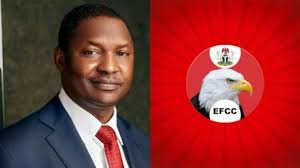
The Economic and Financial Crimes Commission has intensified its asset recovery efforts with the disclosure of 41 properties allegedly linked to former Attorney General of the Federation and Minister of Justice, Abubakar Malami (SAN). According to information contained in court documents and investigative filings, the properties are estimated to be worth a combined value of ₦212 billion.
The assets, which are spread across key cities including Abuja, Kano, and Lagos, are currently under investigation as part of an ongoing probe into alleged financial impropriety and abuse of office. The EFCC maintains that the properties were acquired through proceeds of unlawful activities during Malami’s time in public office, either directly or through associates, proxies, and corporate entities.
Background of the Investigation
The investigation forms part of the EFCC’s broader mandate to trace, identify, and recover assets suspected to have been acquired with public funds or through corrupt practices. In this case, investigators reportedly followed complex ownership structures, bank transactions, and property records before compiling the list presented to the court.
The commission has approached the court seeking orders to preserve the properties pending the conclusion of investigations and possible forfeiture proceedings. At this stage, the assets are not finally seized, as the legal process is still ongoing and subject to judicial determination.
Breakdown of the Properties Identified
Court filings show that the 41 properties include a mix of educational institutions, hotels, religious centres, commercial buildings, residential apartments, and undeveloped lands located in high-value areas.
Some of the notable properties listed include Rayhaan Primary and Secondary School, Zeennoor Hotel, Zeennoor Old Hotel, Zeennoor Mosque, Rayhaan Hotel in Kano, Rayhaan Gym in Kano, and several other properties spread across Kano State.
The list also includes properties located on Ahmadu Bello Way and Amazon Street, as well as multiple assets in Abuja’s Maitama district, including a Maitama branch property and residential buildings identified by plot numbers. In Lagos, investigators reportedly traced properties situated on Lagos Island, an area known for its high commercial and real estate value.
According to the EFCC, many of the assets are income-generating and strategically located, which significantly increases their estimated valuation.
Legal Position and Due Process
The EFCC has emphasized that the matter remains before the court and that no individual has been convicted in relation to the allegations. Under Nigerian law, the anti-graft agency is required to establish that the properties were acquired using illicit funds before any permanent forfeiture can be ordered.
Legal experts note that asset tracing cases of this nature often involve lengthy court proceedings, especially where multiple properties, third-party claims, and corporate ownership structures are involved. The outcome will depend on the strength of evidence presented and the court’s interpretation of the law.
Why the Case Is Significant
The scale of the alleged assets has drawn national attention, making the case one of the most prominent asset-tracing investigations involving a former top government official in recent years. Analysts say it could become a test case for Nigeria’s anti-corruption and asset recovery framework.
If the allegations are proven, the case may strengthen public confidence in accountability mechanisms and serve as a warning against misuse of public office. On the other hand, observers have also stressed the importance of respecting due process and the presumption of innocence until the courts reach a final decision.
Public Reaction and Expectations
The disclosure has triggered widespread reactions across the country, with many Nigerians calling for transparency, a speedy trial, and the recovery of public funds if wrongdoing is established. Civil society groups have urged the EFCC to ensure that the case is prosecuted diligently and without political influence.
Others have called for restraint in public commentary, noting that allegations alone do not amount to guilt and that all parties involved deserve a fair hearing.
Conclusion
The EFCC’s claim that it has traced 41 properties valued at ₦212 billion to former Attorney General Abubakar Malami represents a major development in Nigeria’s ongoing fight against corruption. As legal proceedings continue, the case is expected to remain in the public spotlight, with its final outcome likely to have far-reaching implications for governance, accountability, and public trust in anti-corruption institutions.
Stay Connected with AllMediaplus.com Enjoyed this post? Join our community to receive timely updates, trusted guides, and important news. Join our WhatsApp Group:
https://chat.whatsapp.com/LYOF1rlyCODF2CJsRwxqHc
Follow our WhatsApp Channel:
https://whatsapp.com/channel/0029Vb74OUm9Gv7VtNOVFW21
Like our Facebook Page:
https://facebook.com/allmedia24news

Salim Abubakar is a dedicated content writer and an emerging media professional currently studying at Waziri Umaru Federal Polytechnic Birnin Kebbi (WUFPBK). With a strong passion for journalism, technology, and creative storytelling, he consistently delivers compelling and insightful content for Allmedia24.com.